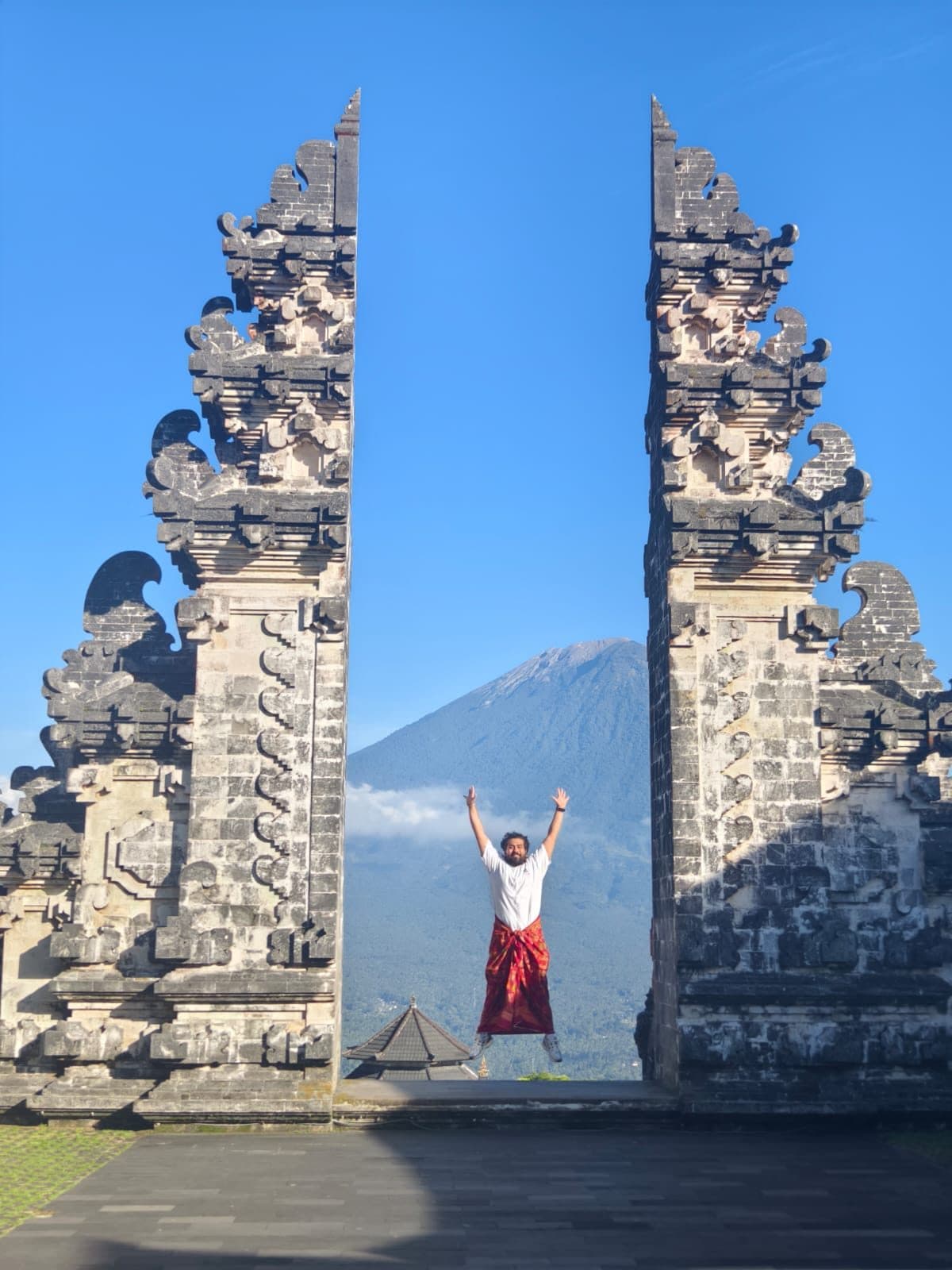
Lempuyang Temple (Gate of Heaven)
Home to Bali's famous 'Gates of Heaven,' framing sacred Mount Agung in the distance.
Pura Lempuyang Luhur is one of Bali's oldest and most highly revered temples, set on the slopes of Mount Lempuyang in the far east of the island. It is best known for its split gate, the candi bentar nicknamed the 'Gates of Heaven,' which famously frames the towering volcano Mount Agung on a clear day. The temple is actually a complex of several shrines climbing the mountainside, with the main lower temple reached by a long flight of steps. Beyond the iconic photo, it remains a deeply important place of worship, and visitors are asked to treat it with respect.
Awan's tips
- The famous 'reflection' in photos is created with a mirror under the photographer's phone, not real water
- Expect a numbered queue for the gate photo; come at opening to keep the wait short
- Awan can leave early so you reach Lempuyang before clouds cover Mount Agung
Highlights
- The iconic 'Gates of Heaven' framing sacred Mount Agung
- One of the oldest and most revered temple complexes in Bali
- A series of shrines climbing the forested slopes of Mount Lempuyang
- Sweeping views across East Bali on a clear morning
- A strong sense of living Balinese spirituality and ritual
Good to know
- Entrance and the gate photo are around $4-6 USD total, with a queue ticket system (approximate, 2026)
- Arrive very early, soon after opening, for clear views of Agung and shorter queues
- A sarong and sash are required; mornings can be cool at altitude, so bring a layer
- Allow 1.5 to 2 hours, more if you continue up to the higher temples
What is Lempuyang Temple and the Gate of Heaven?
Pura Lempuyang Luhur, commonly called Lempuyang Temple, is one of Bali's oldest and most highly revered temple complexes, set on the slopes of Mount Lempuyang in the far east of the island. Like Uluwatu, it is considered one of Bali's directional guardian temples, and it ranks among the holiest sites on the island, drawing pilgrims as well as photographers.
Its global fame, however, comes from a single view: the split gate (candi bentar) at the lower temple, which frames the distant cone of Mount Agung, Bali's highest and most sacred volcano, almost perfectly between its two halves. This composition, often nicknamed the 'Gate of Heaven', became one of the most photographed scenes in all of Bali.
The truth about the 'mirror' reflection photo
The dreamlike images of the gate that show a glassy 'lake' reflecting the sky and the temple are not what you see standing there. There is no reflecting pool at the gate. The mirror effect is created by a photographer placing a piece of glass or a small mirror beneath the phone or camera lens, so it catches a reflection of the scene above.
Knowing this in advance saves disappointment. The view itself is genuinely beautiful, especially on a clear morning when Mount Agung is visible, but the iconic 'water' is a clever photographic trick rather than a feature of the site. Photographers stationed at the gate routinely offer to take this shot for visitors using their own equipment.
The queue system and how it works
Because that one gate is so popular and only one group can be photographed at a time, the lower temple runs an organised queue. On arrival you typically register, receive a number, and wait, sometimes for a long time on busy days, until your turn at the gate, when an attendant helps line up the shot, often with the mirror trick.
Wait times vary enormously with the season and time of day and can stretch to a couple of hours at peak periods, so going early is the single best way to keep the queue short. The photo assistance is generally a paid or tip-based service; build a little patience and some cash into your plan.
- Register on arrival and take a numbered place in the queue
- Expect to wait, potentially over an hour during busy mid-morning periods
- Attendants manage one group at a time at the gate
- The 'mirror' reflection shot is taken for you, usually for a tip or fee
- Arriving early is the most effective way to cut the wait
A multi-temple complex, not just one gate
It is easy to forget that the famous gate is only the lowest shrine of a much larger sacred complex that climbs the mountainside. Pura Lempuyang Luhur, the principal and most sacred temple, sits high above, reached by a long stairway of well over a thousand steps through forest, a demanding climb that rewards the effort with quiet, atmosphere and views very different from the crowded photo spot below.
Many visitors only see the lower gate, but those with the time and energy to go higher experience the site as the pilgrimage destination it truly is. Whichever you choose, remember this is first and foremost a place of worship, not a photo backdrop.
Dress code, etiquette and respectful visiting
As an important Hindu temple, Lempuyang enforces modest dress, and visitors are required to wear a sarong covering the legs, typically available to rent or borrow at the entrance, often with admission by donation. Cover your shoulders, behave quietly, and follow the attendants' directions in the queue and around the shrines.
Be especially mindful that ceremonies may be taking place and that worshippers come here to pray; keep noise down, do not climb on or block sacred structures for photos, and step aside for those who are there for religious reasons. Treating the queue and the staff with patience and courtesy goes a long way at a site that handles very large numbers of visitors.
How to get there, timing, and how it fits a private-driver day
This is the practical catch: Lempuyang is in far east Bali, near Karangasem, and it is a long way from the southern tourist hubs. From Ubud expect roughly two hours or more of driving each way, and from Seminyak, Kuta or the south coast it can be two and a half to three hours or more, depending heavily on traffic and route. It is genuinely a full-day commitment.
Because of the distance and the queue, an early start is close to essential: leaving the south before dawn lets you reach the gate while the morning air is clearest for views of Mount Agung and before the longest queues form. Plan for a long day overall once you add driving, waiting, the visit, and any nearby stops such as Tirta Gangga water palace on the way back.
This is exactly the kind of distant, logistics-heavy destination where a private full-day driver earns their keep. With a local driver like Awan of Black Pepper Bali Tours, you can leave early, sleep on the long drive, have the timing planned around the queue and the light, and combine Lempuyang with other east-Bali sights into one well-paced day rather than wrestling with the distance yourself.
Good to know
Lempuyang Temple FAQs
No. The mirror-like reflection in photos is made using a small mirror held under a phone. There is no pool of water at the gate itself.
As early as possible, ideally at opening. Mornings give the clearest views of Mount Agung and the shortest queue for the gate photo.
Expect around $4-6 USD in total, including the donation and the gate photo queue ticket (approximate, 2026). A sarong is required.
Make a day of it
Combine these stops in one day
Lempuyang Temple pairs naturally with Tirta Gangga, Taman Ujung, Goa Lawah Temple and Besakih — they're easily combined into a single private-driver day on the East Bali Full-Day Tour. Tap any stop for its full guide.

Tirta Gangga
A royal water garden of fountains, ponds, and stepping stones over crystal-clear springs.

Taman Ujung
A grand royal water palace blending Balinese and European design beside the sea and mountains.

Goa Lawah Temple
An ancient seaside temple built around a cave that shelters thousands of bats.

Besakih
Bali's largest and holiest temple complex, set high on the slopes of sacred Mount Agung in the island's east.

Want to see Lempuyang Temple?
Message Awan and he'll build Lempuyang Temple into your day in Bali.
No deposit · Pay at the end · Free cancellation · WhatsApp +62 819-3649-4947